
How to Search Morgan County Warrants
Morgan County posts no official online active-warrant roster. Colorado offers no statewide warrant search either. That means your best route begins with the issuing court, identified from a ticket, notice, case number, or prior order. A felony or district matter normally lands in the Colorado District Court division of the Morgan Combined Court. Misdemeanor and state traffic cases may sit in Colorado County Court. City ordinance and municipal traffic matters stay with the municipal court named on the citation. Before you call, gather the legal name, date of birth, case or citation number, issuing city, and last court date. The date of birth matters. It helps a clerk separate people who share a name, and you should give it only to an official court or records custodian. In the end, the warrant lookup answers one narrow civic question: whether your own case, or a relative's matter, carries a current warrant entry, and which court controls the next step.
- Read the document and identify the court, city, case number, and scheduled date.
- Check the official Morgan County docket, treating it as a schedule rather than a warrant guarantee.
- Call the Morgan Combined Court Clerk at 970-542-5200 for state cases, or the named municipal clerk for city cases.
- Use the court record request form when the docket does not answer the question.
- Call the Morgan County Sheriff at 970-542-3445 for execution or holding confirmation, then confirm any change with the issuing court.
Morgan County Has No Warrant Portal
Morgan County runs no public warrant portal. The sheriff's office offers no warrant database, app, downloadable active-warrant list, or dedicated warrant phone line, and its September 2026 site update added none of these. That gap pushes you toward a phone call rather than a Morgan County warrant search online. Be careful with stand-in tools, too. A private name-search page with no hits is not an official answer, and the sheriff's civil-process page is not a criminal-warrant lookup. Call the main office and ask who handles warrant-status and criminal-justice-record questions.
Quick answer: Morgan County warrant records require court and agency confirmation because no complete official public name-search portal exists.
The official sheriff process page shows how duties are split, though it covers civil service, not warrants. Criminal warrants, protection orders, and civil papers are separate record types. The Morgan Combined Court Clerk holds the court-filed entries. The sheriff may hold service, execution, detention, or return information.
Morgan County Warrant Search Fields
Colorado's Judicial docket interface is the closest official public search screen. It has no warrant-status field, though. Morgan County appears as a county filter, and you must pick at least one filter besides date. Searches can run on a case number, party name, attorney, courthouse, court type, division, or date. What comes back are court events, not a certified statement that any warrant is active or absent.
| Field | Type | Required | Notes |
|---|---|---|---|
| Judicial District | Select | No | Choose the 13th Judicial District. |
| County | Select | No | Morgan is county code 44. |
| Case Number | Year, class, sequence | No | Helps avoid common-name errors. |
| Party Name | Text | No | First and last name fields. |
| Date Range | Select | Yes | One added filter is required. |
| Warrant Status | Not offered | N/A | Confirm with the issuing clerk. |
The official docket screen for Morgan County offers those filters, though it stops short of calling itself a warrant list.
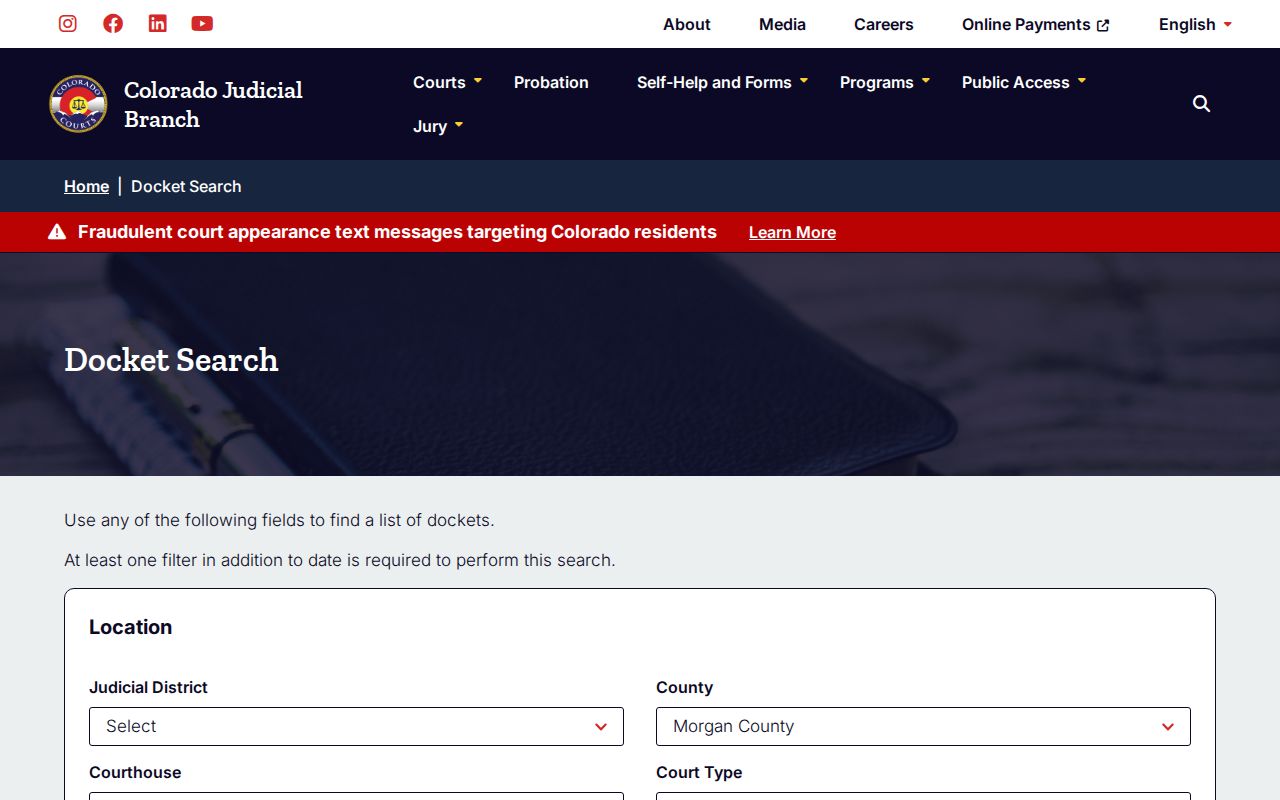
The interface can locate a hearing or case number. That gives the clerk a better starting point for a Morgan County warrant inquiry.
Morgan County Court-First Lookup
For a state-court matter, contact the Clerk of Court at Morgan Combined Court, located at 400 Warner Street in Fort Morgan. The public number is 970-542-5200, and the office takes email at MorganClerksOffice@judicial.state.co.us. Ask whether the register of action shows a missed setting, a bench-warrant or arrest-warrant entry, a bond instruction, or a later recall. A clerk can explain procedure and records. A clerk cannot advise you whether to surrender or what defense to raise. Municipal cases take a different route in Morgan County. Fort Morgan Municipal Court answers at 970-542-3950; Brush at 970-842-5074; Wiggins at 970-483-6161; and Log Lane Village at 970-867-8027. Hillrose publishes no usable court page, so 970-847-3761 is the first number to try for the current clerk. No separate Colorado justice-of-the-peace system applies here.
Note: The court that issued the process controls its recall, even when another agency may serve the Morgan County warrant.
What a Morgan County Warrant Search Returns
A public docket result can show a hearing date, start time, duration, party name, case number, hearing type, location, appearance type, and courtroom. It still does not expose a complete Morgan County warrant record. A lawful request should ask the custodian whether the file contains the fields below and what can be released. The court assigns its own warrant numbers. Ask the clerk rather than guessing at an identifier.
| Process Number | A separate identifier, if assigned; no local public format was verified. |
|---|---|
| Case Number | The court identifier, such as form example 2023AA123456. |
| Charge | The alleged offense and cited law, subject to access limits. |
| Issuing Court | District, county, municipal, or federal venue. |
| Bond | Release terms, distinct from a fine or balance. |
| Status Dates | Issue, execution, return, recall, or quash dates when releasable. |
Capture the exact court label. "Served," "recalled," and "active" carry different effects, and a payment receipt does not prove a Morgan County judge recalled the warrant.
Request Morgan County Warrant Records
When the docket comes up empty, file a tight records request with the Morgan County court. Use the Colorado Judicial record form or write to MorganRecordsRequest@judicial.state.co.us. Spell out the case, the party, a date of birth if known, the county, the year, and the record you want. Good picks include the register of action, the complaint or information, the ticket, and the disposition or sentence order. In the "Other" field, ask for any releasable entries on a warrant, its return or recall, or failure-to-appear process. The official form gives a normal response target of three business days, with more time allowed when circumstances call for it.
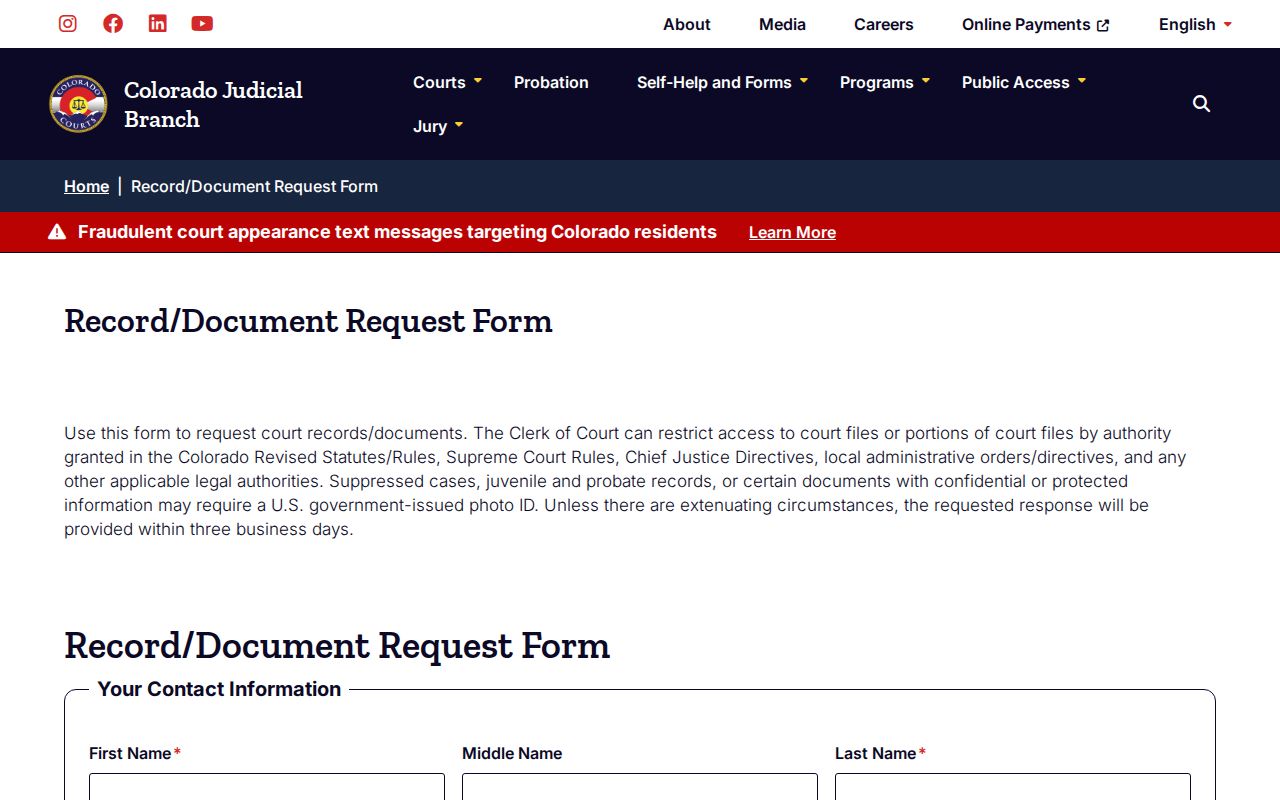
The form also lists copy and research fees, so request an estimate before broad research or redaction. A Morgan County records request gathers documents; it does not recall a warrant.
Where Morgan County Warrants Are Checked
Every Morgan County warrant can leave paper in more than one drawer. The issuing court keeps the core case file, and the Clerk of Court holds district felony files along with county-court misdemeanor and traffic matters. Each municipal clerk keeps its city's ordinance, traffic, code, and municipal misdemeanor records. The Morgan County Sheriff may hold execution, return, detention, or service material, and city police can execute municipal process. So a single event can sit in several offices at once. Colorado's court payment system will search by case number, ticket number, or name. It is a payment tool, nothing more. The state payment interface offers no public warrant-status field.
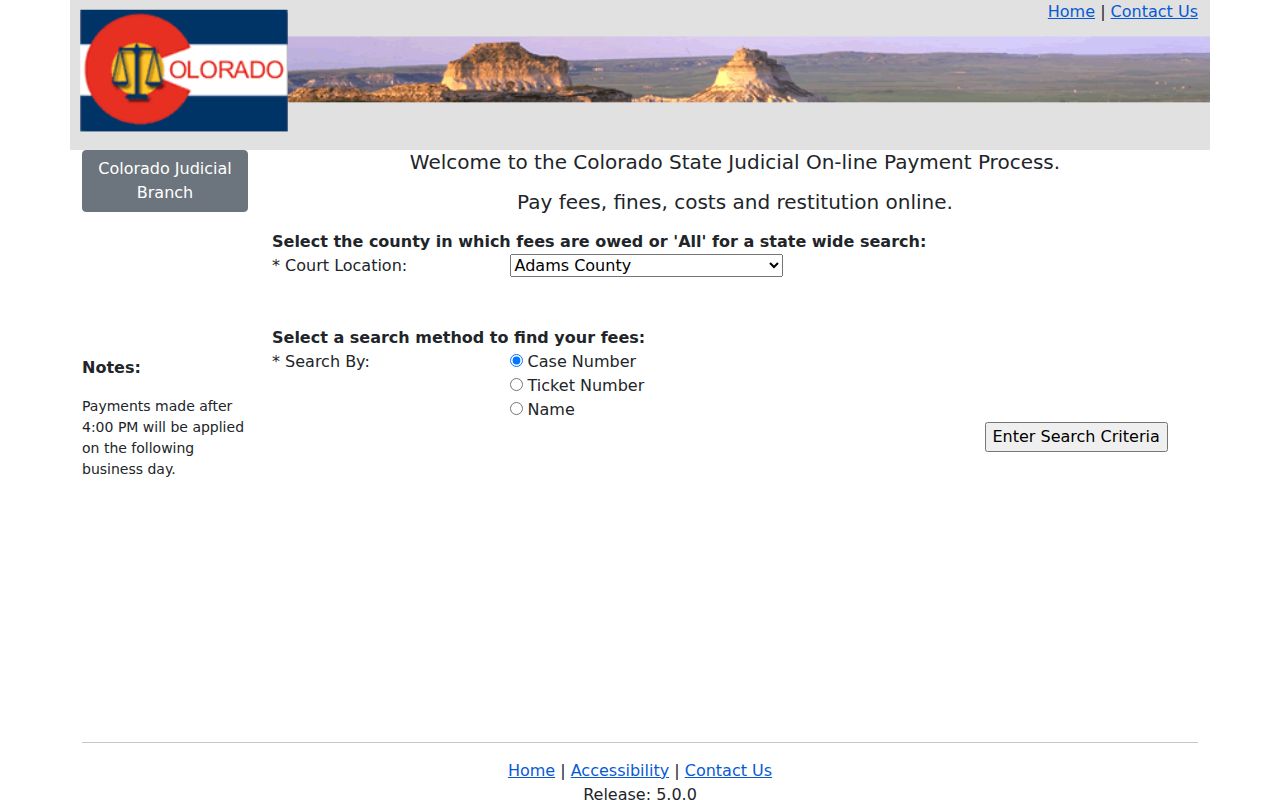
A payable Morgan County case may give you an identifier. Paying does not itself confirm recall, so ask the clerk what order changed the warrant's status and when law enforcement received it.
Morgan County No-Result Meanings
A blank search in Morgan County has several explanations. The name may be misspelled. The case may sit in a city court instead. A new entry may not have posted yet, or the record may be sealed or protected, or the docket tool never indexed warrant status at all. Read the notice and use the case number when you can. Ask the right clerk which reason fits.
- No match
- The filters returned nothing; it is not proof that no warrant exists.
- Wrong venue
- The matter belongs to another court.
- Restricted
- A sealed, juvenile, suppressed, or protected record is not open.
- Data lag
- The agency acted, but the public screen has not caught up.
A blank Morgan County result means little. The Judicial Branch access guide says online register data is limited and not the official record.
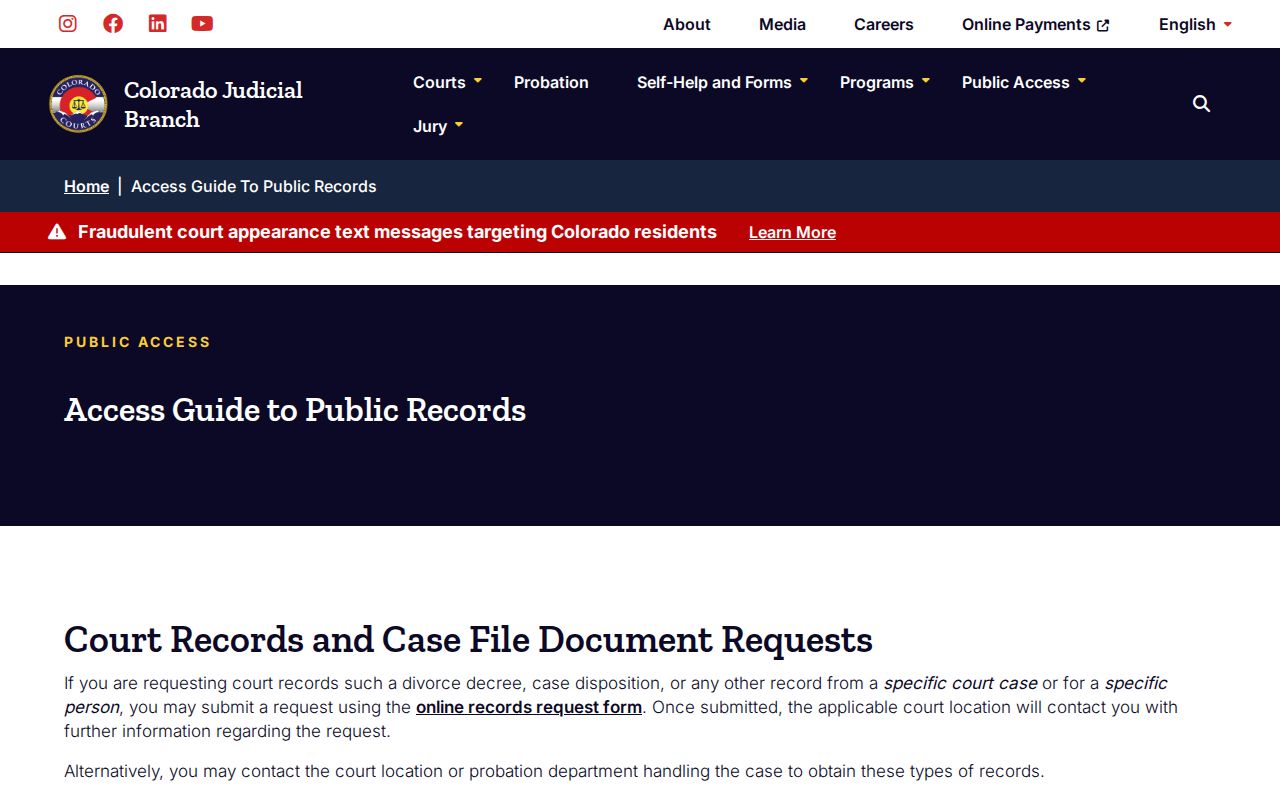
That is why direct court confirmation completes a Morgan County warrant search.
Morgan County Restricted Warrant Access
Access to Morgan County warrant records turns on who holds the file and what state it sits in. Court records follow Judicial Branch policy and Chief Justice Directive 05-01. Sheriff and police files may fall under the Colorado Criminal Justice Records Act, while the Colorado Open Records Act governs other public records. An unexecuted arrest warrant, an open investigation, a protected identifier, a sealed file, or a court order can each block inspection or force redaction. Juvenile material stays closed even where an adult docket would be public. If a request is denied, ask for the legal basis and whether a redacted version could come out. The official access guide routes case-specific questions to the Morgan County court itself.
Key rules:
Sealed and suppressed files do not appear as ordinary public results.
Juvenile records remain subject to controlled access under Colorado law.
Absence from a docket or payment screen is not proof that no warrant exists.
Confirm Morgan County Warrant Changes
Once payment, an appearance, bond, a reset, a recall, or an attorney filing touches a Morgan County warrant, ask the issuing clerk for the exact order or docket entry that changed it. Note the effective date. Ask whether the sheriff or police received the update. Keep the case number, receipt, motion, court order, and confirmation message. Public screens lag. If the Morgan County Sheriff holds the process, call 970-542-3445, or 970-867-2461 after hours for a non-emergency question. Do not assume an in-person inquiry is risk-free. A phone answer does not prevent arrest. Legal counsel can help plan a response, and the issuing court remains the source for recall or quash status.